California Automatic Renewal Law: What the Statute Says
Quick answer
California's automatic renewal law is Business and Professions Code sections 17600 to 17606. It tells businesses what to disclose, how to get consent, how to let you cancel, and when to send notices. The 2024 amendments (AB 2863) apply to contracts entered into, amended, or extended on or after July 1, 2025.
This is general information, not legal advice. The summary below paraphrases the statute text on the California Legislative Information site. Read the statute itself for exact wording.
What the law covers
The statute covers an automatic renewal offer or continuous service offer made to a consumer in California. Section 17601 defines the terms:
- An automatic renewal is a plan where a paid subscription or purchase agreement renews automatically at the end of a set term, or one that contains a free-to-pay conversion.
- A free-to-pay conversion is an offer where you get something free for an initial period and owe payment if you do not take action to cancel before the period ends.
- A consumer is an individual who buys or leases goods, services, money, or credit for personal, family, or household purposes.
Section 17600 states the intent of the Legislature: to end ongoing charging of cards, debit cards, or third-party payment accounts without the consumer's explicit consent.
What the business must disclose
Section 17602 requires the offer terms to appear in a clear and conspicuous manner, before the agreement is fulfilled and in visual proximity to the request for consent. The offer terms are:
- The subscription continues until you cancel.
- The cancellation policy.
- The recurring charge, whether it may change, and the new amount if known.
- The length of the renewal term, or that the service is continuous.
- Any minimum purchase obligation.
If the offer includes a free gift or trial, the business must explain the price that will be charged after the trial ends. Clear and conspicuous means larger type than the surrounding text, contrasting type, font, or color, or set off by symbols or marks.
Consent and the acknowledgment
The business may not charge your card or third-party account for an automatic renewal without first getting your affirmative consent to the terms. It must also obtain express affirmative consent to the offer terms and keep verification of that consent for at least three years, or one year after the contract ends, whichever is longer.
After you sign up, the business must provide an acknowledgment you can keep. It has to include the offer terms, the cancellation policy, and how to cancel. For a free trial, the acknowledgment must also say how to cancel and the business must allow you to cancel before you pay.
Notices before charges
Section 17602(b) requires a reminder notice in two situations:
- Long trials and promotional prices. If a free gift, trial, or discounted price lasts more than 31 days, the notice goes out at least 3 days and at most 21 days before that period expires.
- Annual or longer terms. If the initial term is one year or longer and renews automatically, the notice goes out at least 15 days and at most 45 days before renewal.
The notice must say the plan renews unless you cancel, the length of the renewal period, the amount or range of costs, how to cancel, and the business's contact information. If it is sent electronically, it must include a link to the cancellation process or another reasonably accessible electronic method.
The text includes an exemption from the free-trial notice when the consumer did not sign up electronically and the business has not collected a valid email address, phone number, or other electronic contact.
Other notices in the statute:
- Fee changes. For a change in the fee, the business must give notice no less than 7 days and no more than 30 days before the change takes effect, along with information about how to cancel.
- Material changes. The business must give clear notice of a material change in terms and how to cancel.
- Annual reminders. For annual agreements, the business must send an annual reminder in the same medium that activated the plan or one the customer is used to, showing the product, the frequency and amount of charges, and how to cancel.
How cancellation must work
Section 17602(c) to (f) is the part most readers want.
- The business must provide a toll-free telephone number, an email address, a postal address if it bills you directly, or another cost-effective, timely, and easy-to-use mechanism.
- If you can accept the offer online, the business must let you terminate online, at will, without extra steps that obstruct or delay you. The method is a prominently located direct link or button in your account, profile, or settings, or an immediately accessible termination email you can send without additional information.
- A business may require you to sign in before cancelling online. If you cannot or will not sign in, you must still be able to cancel by another method.
- Cancellation must be available in the same medium you used to sign up, or the one you are used to using, such as in person, by telephone, by mail, or by email.
- If a phone line is the cancel route, the business must answer calls promptly during normal business hours and not obstruct or delay cancellation. If you leave a voicemail asking to cancel, the business must process the cancellation or call you back within one business day.
Retention offers are allowed with conditions. By phone, the business may present a discount or information about the effects of cancelling only after telling you plainly that you can complete cancellation at any time by saying cancel. Online, the business may show a discount or retention offer while simultaneously displaying a prominently located direct link or button titled click to cancel, or words to that effect. In both cases, once you say you want to cancel, the business must promptly process it.
Goods sent without consent
Section 17603 says goods sent under a continuous service or automatic renewal without the consumer's affirmative consent are deemed an unconditional gift to the consumer, who may use or dispose of them with no obligation, including no cost of shipping them back.
Remedies and exemptions
Section 17604 says a violation is not a crime, but all available civil remedies that apply to a violation may be used. It also says a business that complies with the article in good faith is not subject to civil remedies.
Section 17605 lists exemptions, including services regulated by the California Public Utilities Commission, the Federal Communications Commission, or the Federal Energy Regulatory Commission, entities regulated by the Department of Insurance, alarm company operators, banks and credit unions and other financial institutions licensed under state or federal law, and certain service contract sellers.
What California's Attorney General suggests
The California Attorney General's page on free trials says companies must explain the terms plainly and get your approval before enrolling you in an automatic renewal. Its tips: read the terms, uncheck pre-selected boxes, track trial end dates, and review card statements. If you are charged wrongly, the page lists three steps. Try to resolve it with the company, then contact your credit card company to dispute the charge, then report the company to the Attorney General's Public Inquiry Unit, the FTC, or the Better Business Bureau.
For card disputes, the Attorney General's page on disputing charges says a written billing-error dispute should reach the card company within 60 days of the first bill showing the charge, and that the company has 30 days to acknowledge your letter and 90 days to investigate.
Where SubSweeper fits
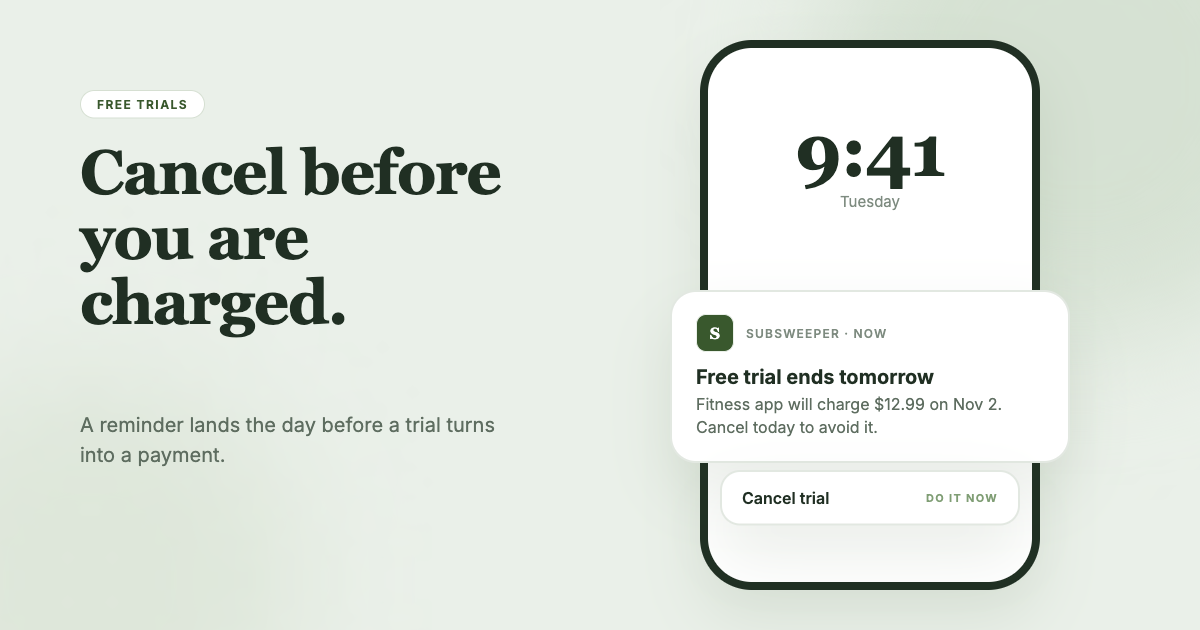
California's notice rules assume you read the email when it arrives. SubSweeper scans your email receipts (read-only) and puts active subscriptions, free trials, and upcoming renewals in one dashboard, with reminders before charges, so a renewal date does not depend on one email in a crowded inbox. It also helps you cancel.