Automatic Renewal Laws by State: An Overview
Quick answer
There is no single nationwide automatic renewal statute. Federal law (ROSCA) covers online sales, and an assortment of state laws adds rules that vary. This article summarizes what I confirmed from official texts for California, Virginia, New York, and Minnesota, and shows how to look up your own state. It is not a 50-state table.
This is general information, not legal advice.
The federal layer
In a March 2026 Federal Register notice, the FTC described the existing federal rules. It calls the Restore Online Shoppers' Confidence Act (ROSCA) the only federal law primarily designed to regulate negative option marketing, and says it is limited to transactions on the internet. Under ROSCA, as the FTC summarizes it, a seller using a negative option feature online must disclose all material terms in a clear way before getting your billing information, get your express informed consent before charging, and provide simple mechanisms to stop recurring charges.
The same notice says an assortment of state laws also regulates negative option marketing, providing varying levels of protection. It names California, Colorado, Vermont, and Virginia as examples. The FTC's own 2024 click-to-cancel rule was vacated by a federal appeals court in 2025, so state laws and ROSCA are what remain. The status is covered in our FTC click-to-cancel article.
California
California's law is Business and Professions Code sections 17600 to 17606, updated by AB 2863 for contracts entered into, amended, or extended on or after July 1, 2025. Points from the statute text:
- Offer terms must be disclosed in a clear manner, near the request for consent.
- Consumers who can sign up online must be able to cancel online, at will.
- For free trials and promotional prices longer than 31 days, a notice goes out 3 to 21 days before the period ends.
- For annual terms, a notice goes out 15 to 45 days before renewal.
- Fee changes require notice 7 to 30 days beforehand.
Our California automatic renewal law article goes through each section.
Virginia
The FTC notice cites Virginia Code section 59.1-207.46. The text I read on the Virginia Law site says a seller must present the offer terms in a clear and conspicuous manner before the consumer becomes obligated, and cannot charge a card, debit card, or third-party account without first obtaining the consumer's affirmative consent. The seller must give an acknowledgment the consumer can keep, with the offer terms, the cancellation policy, and how to cancel; for a free trial, it must also explain how to cancel before payment is due.
On cancellation, the section requires a cost-effective, timely, and easy-to-use mechanism. The text says it must be at least as easy to use as the mechanism used to sign up, available through each method the consumer used to enroll (with exceptions for in-person sign-ups), and must not require speaking with an agent unless sign-up was agent-based. Telephone cancellation must be free and promptly processed. For free trials lasting more than 30 days, the seller must notify the consumer of the option to cancel before the trial ends.
New York
New York General Obligations Law section 5-903 applies to contracts for service, maintenance, or repair. The text says an automatic renewal provision is enforceable against the recipient only if the provider gave written notice calling attention to the provision, between 15 and 30 days before the date by which the recipient must send a termination notice, delivered personally or by certified mail. The section does not apply to contracts where the automatic renewal period is one month or less. That scope is narrower than a typical streaming or app subscription, so read the section before assuming it applies to yours.
Minnesota
Minnesota's automatic renewal provisions begin at Minnesota Statutes section 325G.56. The page I opened contains the definitions: automatic renewal, continuous service, indefinite subscription agreement, clear and conspicuous, and the offer terms (that the agreement continues until terminated, the cancellation policy, recurring charges and any likely change in amount, the length of the renewal term, and any minimum purchase obligation). The substantive requirements sit in the following sections of the statute, which I did not read, so I am not summarizing them here.
Colorado and Vermont
The FTC notice names Colorado Revised Statutes section 6-1-732 and Vermont Statutes Annotated title 9, section 2454a as state negative option laws. I did not open the statute text for either, so I cannot say what they require.
How to check your own state
- Search your state's official statute website for automatic renewal, continuous service, or free-to-pay conversion. Those are the terms that appear in the California and Virginia texts.
- Check your state attorney general's consumer page. California's page on free trials, for example, tells people to read terms, uncheck pre-selected boxes, track trial end dates, and report problems to the Attorney General's office.
- Read the terms of the specific subscription. They state the cancellation method the company says applies.
- Look at the date on the statute and any amendment note. The California text shows its latest amendment (AB 2863, effective January 1, 2025, applying to contracts from July 1, 2025). Laws in this area change, and a copy that is a few years old may be out of date.
Why the rules differ
State laws differ on who they cover, what notices they require, and how they let you cancel. The California text covers consumers buying for personal, family, or household purposes. The New York text covers certain service, maintenance, and repair contracts and exempts renewal periods of one month or less. The Virginia text speaks of a cancellation method as easy as the sign-up method. Which one applies to you depends on where you live and what you bought, and the company's terms may name a governing state. If the question is a legal one, such as whether a specific charge broke a specific law, that is a matter for a lawyer or your attorney general's office.
What stays the same everywhere
Regardless of the state, the FTC's consumer guidance on free trials and subscriptions applies as practical steps. Read the terms. Follow the company's cancel instructions. Save a copy of your request. Watch your statements. If you are still charged, dispute the charge with your card issuer and report the problem at ReportFraud.ftc.gov or to your state attorney general.
Where SubSweeper fits
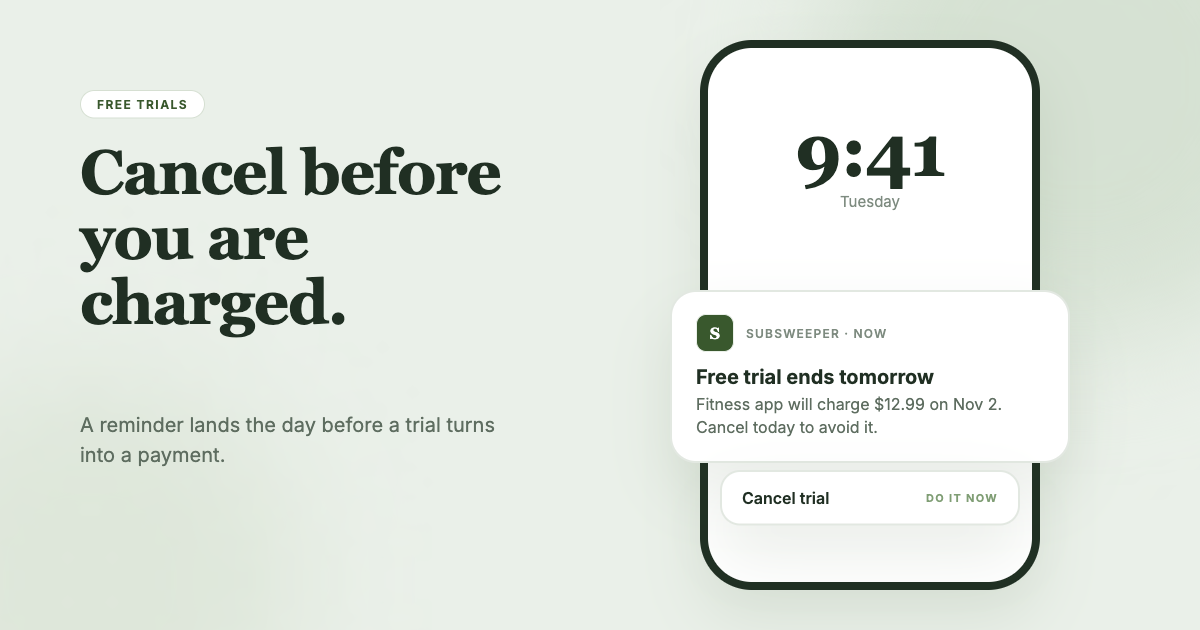
Whichever state's rules apply, the notice deadlines depend on knowing what you are subscribed to. SubSweeper scans your email receipts (read-only) and lists active subscriptions, free trials, and upcoming renewals in one dashboard, with reminders before charges. It also helps you cancel.
Official sources
- federalregister.gov/documents/2026/03/13/2026-04952/rule-concerning-the-use-of-
- leginfo.legislature.ca.gov/faces/codes_displayText.xhtml?lawCode=BPC&division=7.&title
- law.lis.virginia.gov/vacode/title59.1/chapter17.1/section59.1-207.46/
- nysenate.gov/legislation/laws/GOB/5-903
- revisor.mn.gov/statutes/cite/325G.56
- oag.ca.gov/consumers/general/free-trial-offers