Subscriber Fatigue Hits Music Streaming, What It Means for
Quick answer
Paid US music subscriptions kept growing, but slowly. The Recording Industry Association of America (RIAA) counted 99 million paid streaming subscriptions in the first half of 2024, up 3%. Slower growth means fewer new listeners to chase, so services lean on offers and bundles to keep the ones they have. Check each music charge on your statement and keep only the services you open every week.

The RIAA's mid-year report for 2024 put the first-half figure at 99 million paid subscriptions, up 3% over the first half of 2023. That is still growth, though a modest one, and it shapes what you see in your inbox: promotions, trial offers, and bundled plans.
What the RIAA data says
The 2024 mid-year report, dated August 29, 2024, says streaming subscriptions were up 3% to 99 million over the first half of 2024. Paid subscriptions also made up nearly two-thirds of the added value in the period. Recorded music revenue grew 4% to $8.7 billion in estimated retail value, and 3% to a record $5.5 billion at wholesale value.
The trend continued in later reports. RIAA's reports page says its 2024 year-end report showed paid streaming reaching 100 million subscriptions for the first time. For the first half of 2025, it says paid accounts grew 6.4% to 105 million, with paid subscription revenue up 5.7% to $3.2 billion. The 2026 mid-year report, dated September 1, 2026, says streaming made up 82% of US recorded music revenue at $4.9 billion, powered by paid subscriptions.
So the market did not shrink. It grew from 99 million to 105 million paid accounts across a year, which is steady but modest. The useful reading for a household is that the number of people who will pay for music is rising slowly, and every service is competing for the same listeners.
What this means for your own subscriptions
The RIAA figures count accounts across the whole industry. They do not tell you which services are gaining or losing listeners, and they do not break out any single company. Claims about which individual services are gaining or losing subscribers are left out here because no official source backs them.
What the totals do suggest is practical. When growth is slow, services compete for the listeners they already have. That usually shows up as retention offers, bundles with other products, and new plan types. Each one is a reason to look at your own spending instead of letting it renew by default.
A short audit for your music subscriptions
List every music charge from the last three months. Check your card statements, Apple and Google subscription lists, and any phone carrier bill.
Note which services you opened in the last 30 days. If you cannot remember, that is your answer.
Check whether you pay twice for the same thing, for example a standalone plan plus a bundle that includes music.
Cancel the extras, and keep the confirmation.
How to cancel the main services
Spotify Premium. Spotify's help page says to open your account's plan page, labeled Manage your plan, and select Cancel subscription. Premium access continues until the end of your current billing period, then the account moves to the free plan. Your playlists and saved music stay in your library, and you can still log in and listen with ads. If you cancel during a free trial that has no charge, the account moves to the free plan right away and the trial cannot be restarted. If you see no option to cancel, the plan is probably billed through a partner such as a mobile or internet provider, and you cancel with them. On a Family or Duo plan, only the plan manager can cancel the plan.
Apple Music and other App Store subscriptions. Apple's support page says to open Settings, tap your name, tap Subscriptions, tap the subscription, and tap Cancel Subscription. You may need to scroll down to find it. On a Mac, use the App Store, click your name, then Subscriptions. For a trial you do not want to keep, cancel at least 24 hours before it ends.
Subscriptions billed by Google Play. Google's help page says to open subscriptions in Google Play, select the subscription, tap Cancel subscription, and follow the on-screen instructions. After you cancel, you keep access for the period you already paid for and you are not charged at the next renewal. Some apps also offer a pause option, with periods from one week to three months depending on the app.
Cancel steps for YouTube Music and Amazon Music were not confirmed on their official help pages while this guide was prepared, so check each service's own help center for current instructions. If either one is billed through Apple or Google Play, the store steps above apply.
Why one service is usually enough
Most people play a small set of playlists and albums, and catalogs overlap heavily across services. If you keep two paid plans, ask what the second one gives you that the first does not: a specific artist's exclusive content, better audio for one device, or a family plan the household shares. If you cannot name something, you are paying for habit.
Keeping the list current
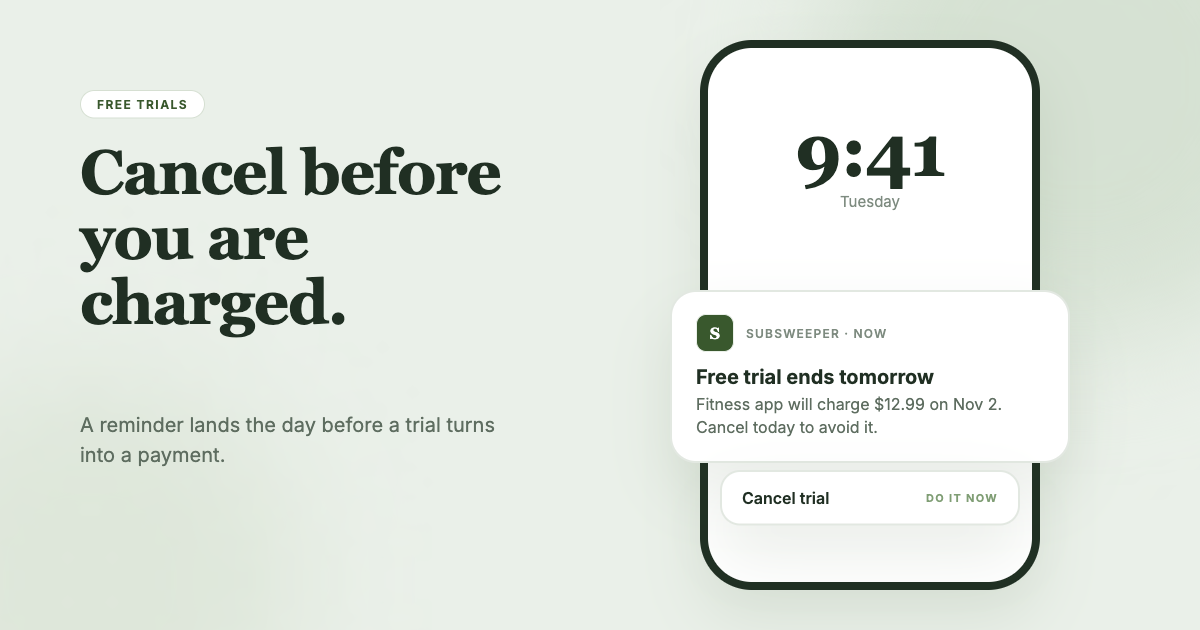
A one-time audit helps for a few months, then trials and promotional plans pile up again. SubSweeper scans your email receipts (read-only) and shows your active subscriptions, free trials, and upcoming renewals in one dashboard, with the monthly total and categories. It also sends reminders before charges, so a music plan you forgot about shows up before it renews.