How to Stop a Recurring Payment on Capital One
Quick answer
Capital One's help center describes a recurring transactions tool for credit cards called Expected Transactions. You can block a recurring charge for 12 months, or cancel it, which takes about 5 calendar days. Use it after you have cancelled with the merchant, so the charge fails at the card level too.
If a charge posts anyway, dispute it. Federal rules give you 60 days from the bill with the error to get a written notice to the card issuer.
Block or cancel: what is the difference
Capital One's recurring transactions page offers two actions.
Block. The block lasts 12 months. Capital One refuses charges from that merchant for the period. Use it when a company has charged you after cancellation, or when you aren't sure the cancellation went through.
Cancel. The cancel request takes about 5 calendar days to take effect. Use it to end a recurring arrangement that you no longer want.
The delay on cancel matters. If a charge is due within the next few days, a cancel request may arrive too late for that billing date. Request it as soon as you know, and treat a block as the faster shield when it applies.
Look for the Expected Transactions feature in your online account or app, or follow the instructions on the help page. Menu labels can change, so use the page for the current path.
Cancel with the merchant first
A block stops one card from paying. The merchant can still send bills and treat your account as open. Cancel inside the merchant's account settings or contact the company, and get a confirmation by email or number.
The CFPB gives the same advice for bank payments: stopping payments does not cancel what you owe. Cancel the service and settle any final balance directly.
Dispute a charge that still posts
Capital One has separate dispute pages for credit card charges and debit card charges. Start from the one that matches your card.
For credit cards, the federal process is the same at every issuer. The CFPB and the FTC describe it:
- Call the card company about the charge.
- Send a written billing error notice to the billing inquiries address, not the payments address. Include your name, address, account number and a description of the error.
- Get the letter to the issuer within 60 days after the first bill with the error was sent to you. Send it by certified mail with a return receipt.
- Attach copies of your cancellation confirmation and keep the originals.
- Watch for the issuer's written acknowledgment within 30 days. The FTC says the issuer must resolve the dispute within 90 days.
While it's open, you can withhold the disputed amount and its related finance charges. You still pay the rest. During the investigation, the issuer cannot sue you for the disputed amount, close or restrict your account because of the dispute, or report you as delinquent over it.
If the charge came from a Capital One checking account
Capital One's public help pages I could open cover the card tools above. They did not give a menu path for stopping an ACH debit from a checking account, so the federal process is the safe guide:
- Tell the company in writing that you revoke permission to debit your account.
- Tell Capital One in writing too.
- Ask Capital One about a stop payment order and its fee. The CFPB says banks generally charge one.
- Notify the bank at least 3 business days before the payment date. The bank may require written confirmation within 14 days of an oral notice.
Payments taken after both notices are errors. You can ask your bank for a refund. If the bank and the company ignore you, the CFPB takes complaints at (855) 411-2372, and your state attorney general also does.
A charge you don't recognize
If you did not sign up with the merchant, treat the charge as possible fraud. Report it to Capital One right away. For debit transactions, the CFPB says reporting within 2 business days of learning about an unauthorized transaction limits your liability to $50, and reports should reach the bank within 60 days of the statement showing it.
When to use block and when to dispute
Use the block after you cancel and before the next billing date, when you want a hard stop at the card. Use a dispute after a charge has posted and you want the money back. The two work together: block the merchant for 12 months, then dispute the charge that already went through.
If you only dispute, a merchant that has your card on file can charge again next month and you start over. If you only block, the earlier charge stays on your bill.
A quick checklist before you call
- The merchant's name as it appears on the statement.
- The date and amount of each charge.
- Your cancellation confirmation, with date.
- Notes on who you spoke with at the merchant.
Having these in front of you shortens the call and strengthens a written dispute.
Catch renewals before the block
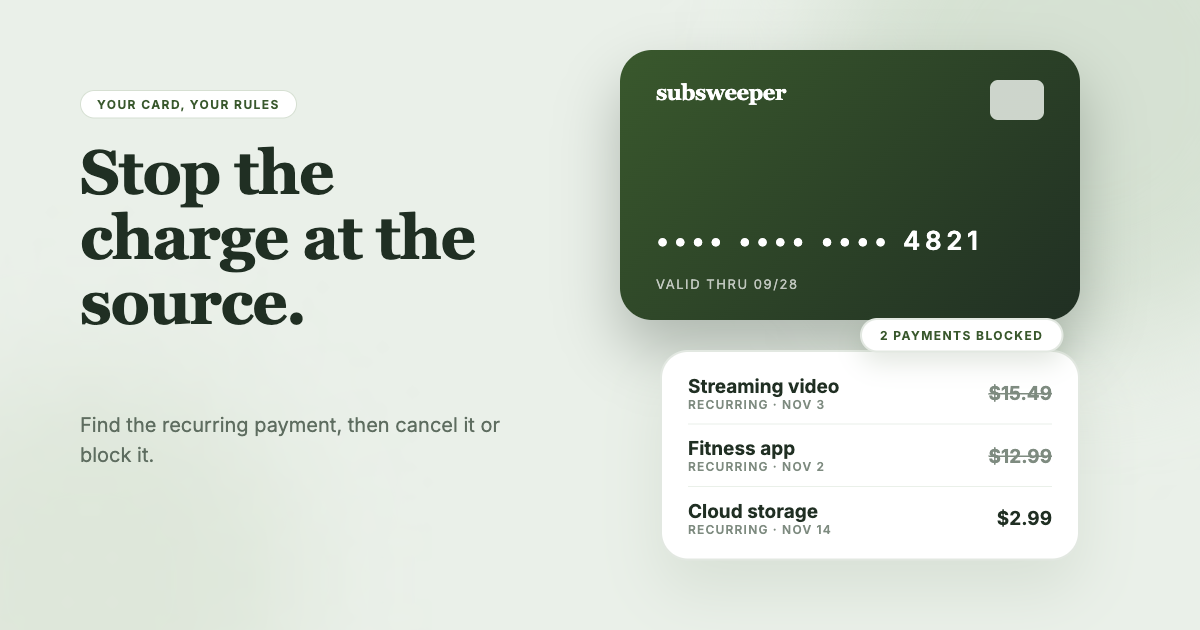
A block is a good safety net, but it works best as a second layer. SubSweeper scans your email receipts (read-only) to show active subscriptions, free trials and upcoming renewals in one dashboard. It sends reminders before charges and helps you cancel, so most subscriptions end before you need to block anything.
Official sources
- capitalone.com/help-center/credit-cards/recurring-transactions/
- capitalone.com/help-center/fraud-disputes/dispute-credit-charge/
- capitalone.com/help-center/fraud-disputes/dispute-debit-charge/
- consumerfinance.gov/ask-cfpb/how-do-i-dispute-a-charge-on-my-credit-card-bill-e
- consumer.ftc.gov/articles/using-credit-cards-and-disputing-charges
- consumerfinance.gov/ask-cfpb/how-do-i-stop-automatic-payments-from-my-bank-acco
- consumerfinance.gov/ask-cfpb/how-can-i-stop-a-payday-lender-from-electronically