Revoke Authorization and Block a Company From Charging You
Quick answer
Send the company a written notice that you revoke permission to charge your card or account. Then back it up with your bank or card issuer: a stop payment order for a debit, a block or dispute for a credit card, or a new card number for either.
The notice makes later charges errors. The bank or issuer step makes them hard to collect. None of it cancels what you owe.
Why the company comes first
A company charges you under an authorization you gave when you signed up. Your bank or card issuer follows that authorization until you tell it otherwise. The CFPB's guidance starts with the same step: tell the company you are revoking permission.
Put it in writing. A phone call is fine for starting, but a dated email or letter is proof you can send to your bank or issuer later.
What to put in the revocation notice
Keep it short and plain:
- Your name and the account, order or customer number.
- The card or account being charged, by the last four digits only.
- A clear statement, such as: I revoke my authorization for any further charges to this card or account.
- The date from which it applies, which is today.
- A request for written confirmation.
Send it by email and by a trackable method if you can. Keep copies. Leave the full card number and bank account number out of the message.
For a debit card or bank account
Bank debits follow Regulation E. After your notice to the company:
- Tell your bank in writing that you revoked permission.
- Consider a stop payment order. The CFPB says banks generally charge a fee for one.
- Notify the bank at least 3 business days before the scheduled payment. You can use any channel.
- If you called, expect to send written confirmation within 14 days when the bank requires it. The rule text in 12 CFR 1005.10 says an oral notice stops binding the bank after 14 days without it.
Payments taken after both notices are errors. You can ask for a refund.
For a credit card
Credit cards work differently, and a lock is the wrong tool. Chase says on its unauthorized charges page that locking a card does not block recurring transactions. American Express says its freeze does not stop recurring bills and lasts 7 days.
Your options:
- A block tool. Capital One lets you block a recurring charge for 12 months or cancel it, which takes about 5 calendar days.
- A new card number. Replace the card and give the new number only to companies you still want to pay. Chase advises updating recurring merchants after a replacement.
- A dispute. For a charge that posts after you revoked, send a written billing error notice. The FTC says it must reach the issuer within 60 days after the first bill with the error was sent. The issuer must acknowledge it in writing within 30 days and resolve it within 90 days.
The CFPB says to call the card company first and then write. Use the billing inquiries address, not the payments address.
While a dispute is open, you can withhold the disputed amount. The issuer cannot sue you for it, close or restrict your account over it, or report you delinquent for it.
Use a card that the company cannot reuse
If you expect trouble with a company, start with a card number you can shut off. Privacy.com offers virtual cards you can pause or close. Its help page says a pause is reversible, a close is permanent, and authorizations made earlier are still honored. A closed card gives the company nothing to charge, and you didn't need to ask permission to end it.
Keep proof of every step
Save the revocation notice, the company's reply, the date you contacted your bank or issuer, and any confirmation number. If a charge posts later, those records show you told both sides to stop, which is what a refund request or dispute rests on. The CFPB tells you to keep records at each step, and a single folder with dated copies is enough.
If the company says it will keep charging because of a contract term, ask it to state that in writing. A written reply tells you whether you are facing a billing error or a real balance.
What revoking does not do
It does not cancel a debt. The CFPB says canceling payments does not cancel what you owe. A balance, a lease or a contract term stays with you. A company you owe can send bills, add fees if your contract allows them, or turn to collections.
Handle the debt separately. Ask for a final bill, and pay it by a method you control, such as a one-time payment. Do not let a revoked authorization turn into a missed balance.
Getting help
If the company keeps charging after you revoked, file a complaint with the CFPB at (855) 411-2372 or with your state attorney general. Attach your revocation notice and your bank or issuer notice.
Revoke the right company
The hard part is often figuring out who is charging you. A line on a statement can carry a payment processor's name and not the brand you signed up with.
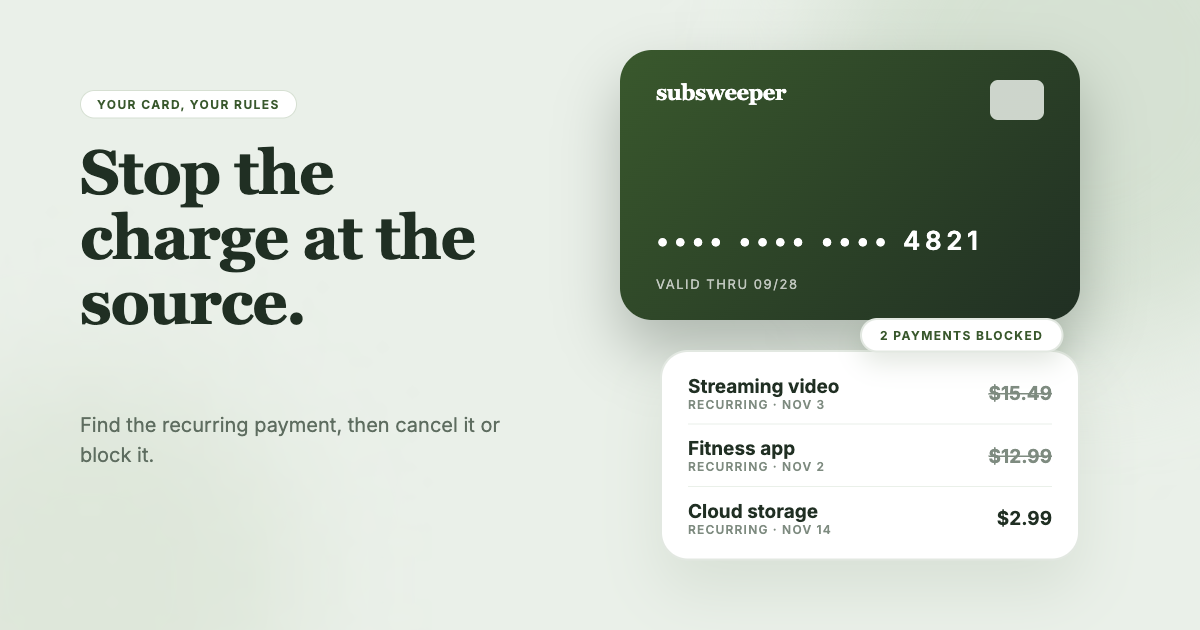
SubSweeper scans your email receipts (read-only) and shows active subscriptions, free trials and upcoming renewals in one dashboard, so you can match a charge to a company. It sends reminders before charges and helps you cancel.
Official sources
- consumerfinance.gov/ask-cfpb/how-do-i-stop-automatic-payments-from-my-bank-acco
- consumerfinance.gov/ask-cfpb/how-can-i-stop-a-payday-lender-from-electronically
- consumerfinance.gov/ask-cfpb/how-do-i-dispute-a-charge-on-my-credit-card-bill-e
- consumer.ftc.gov/articles/using-credit-cards-and-disputing-charges
- chase.com/digital/customer-service/fraud/unauthorized-charges
- americanexpress.com/us/customer-service/faq.what-happens-when-i-freeze-my-card.
- capitalone.com/help-center/credit-cards/recurring-transactions/
- support.privacy.com/hc/en-us/articles/360039148094
- ecfr.gov/api/renderer/v1/content/enhanced/current/title-12?part=1005