How Subscriptions Work: A Complete Guide
With a subscription, customers pay a recurring fee (monthly, quarterly, or yearly) for continued access to a product or service instead of making a single purchase. Streaming platforms, SaaS tools, meal kits, and beauty boxes all use the model. Knowing how it works helps both companies and users decide better.
What Is a Subscription Model?
A subscription is a recurring payment system. Consumers agree to be billed regularly in return for ongoing value. For businesses, this creates predictable revenue. For customers, it removes the need for repeat purchases and often saves money.
Billing is usually automatic. Once a user signs up and enters payment details, renewals happen on a schedule until canceled.
How billing and renewal work
Most subscriptions follow the same sequence. You pick a plan and a billing period, the service charges your payment method, and it charges again at the start of every period until you cancel. Terms differ by company. For example, Dashlane's terms say subscriptions renew for the same length as the expiring period at the rates in effect at renewal, and that Dashlane informs you at least 30 days before the renewal date. The New York Times says its recurring subscriptions renew until you cancel, and that cancellation takes effect at the end of the current billing period. Function Health's terms say it may change subscription pricing and will use reasonable efforts to notify you by email. Read the renewal clause of any plan before you pay.
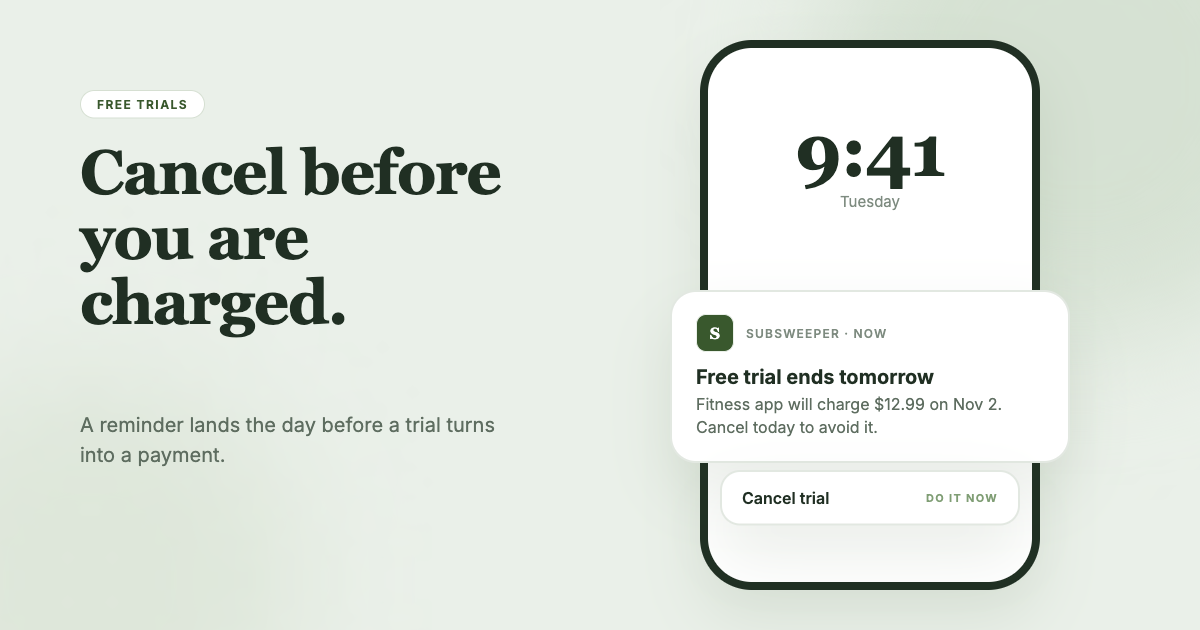
Free trials usually convert to paid plans. Dashlane and the New York Times both state in their terms that a trial converts to a paid subscription unless you cancel first. Apple advises canceling at least 24 hours before a trial ends.
Who bills you: the company or an app store
A subscription can be billed by the company itself or by a platform such as Apple or Google Play. This matters because you can cancel only where you were billed. A subscription bought through the iOS App Store is canceled in your Apple Account, and one bought through Google Play is canceled in Google Play. The New York Times Terms of Sale say this directly for its own subscriptions: if you bought through Google Play or iOS, cancel through that third party.
Types of Subscriptions
Subscriptions apply to nearly any industry. The most common categories are:
Digital subscriptions: streaming platforms, e‑books, online news, and software as a service (SaaS), delivered on demand.
Product subscriptions: consumer goods such as meal kits, coffee deliveries, or grooming products, often sold as subscription boxes.
Membership models: gyms, coworking spaces, and premium clubs where members pay to maintain access.
Hybrid subscriptions: companies offering both physical products and digital features.
Why Businesses Use Subscriptions
For companies, the subscription model provides:
Predictable revenue: monthly billing makes financial planning easier.
Customer retention: subscriptions encourage long‑term relationships instead of one‑time sales.
Scalability: digital platforms can grow with minimal added cost.
Data insights: ongoing billing gives companies data on user behavior, which they can use to improve the service.
Netflix, Spotify, and Microsoft 365 all rely on recurring payments.
Benefits for Customers
Convenience: no need to reorder; products and services arrive consistently.
Cost efficiency: many subscriptions are cheaper than paying per use.
Personalization: subscription boxes and apps often adapt to user preferences.
Access to premium features: many platforms use a freemium strategy where the subscription unlocks more.
Possible Downsides
Customers may accumulate too many active subscriptions and lose track of payments. Automatic billing can lead to paying for unused services. Businesses must keep providing value to prevent cancellation. Churn rate, the percentage of people who stop subscribing, is one of the main metrics in the industry.
Refunds are another downside. Terms commonly say fees are not refundable after a renewal. The New York Times says its subscription fee is nonrefundable except where its terms or the law say otherwise. Creator Buddy states that all payments are non-refundable and that it gives no prorated refunds. Dashlane refunds annual plans if you ask within 30 days of the start or renewal, but its terms say monthly plans are not refundable. Function Health refunds in full if you cancel within 48 hours of purchase and no lab testing has happened, and treats later payments and renewals as nonrefundable. Check the refund clause before you buy.
What happens when you cancel
Cancellation usually stops the next charge but not the current period. Google Play says you keep access until the end of the period you paid for, and gives the example of a yearly plan bought January 1 and canceled July 1, which stays active until December 31. Function Health's terms say cancellation generally takes effect at the end of the billing cycle in which you cancel. Deleting an app does not cancel its subscription. Canceling also does not always delete your account or data, which is a separate step on many services.
How to Choose and Manage a Subscription
Review subscriptions regularly to avoid paying for unused services.
Compare plans before committing. Annual subscriptions may cost less than monthly ones.
Use apps or reminders to track renewals and cancellations.
Look for providers with clear cancellation policies and multiple tiers.
To find what you already pay for, open the subscription list in your Apple Account (Settings, your name, Subscriptions) and in Google Play (play.google.com/store/account/subscriptions), then scan your card statement for charges that repeat.
When a charge is wrong
Contact the company first. For Apple purchases, request a refund at reportaproblem.apple.com. If a credit card charge is a billing error, the FTC says to write to your card issuer's billing inquiries address within 60 days after the first bill with the error was sent. Include your account number, a description of the error, and copies of receipts. The issuer must acknowledge your letter within 30 days and resolve the dispute within 90 days of receiving it.
The Future of Subscription Services
Industries that traditionally relied on one‑time sales are moving toward recurring payments. Cars, fashion, and even healthcare now experiment with subscription plans.
Frequently asked questions
Do subscriptions renew automatically?
Usually yes. Most plans renew at the end of each period until you cancel, and the renewal price can differ from the sign-up price.
Will I get a refund if I cancel mid-month?
It depends on the company. Several services state that fees are nonrefundable, so read the refund clause before you buy.
Why can't I cancel in the app?
If an app store bills you, you cancel in the store. If the company bills you directly, you cancel in the account settings on its website.
Does a free trial charge me automatically?
Often yes. Trials commonly convert to paid plans unless you cancel first.
Sources
SubSweeper can track and cancel subscriptions in one place at subsweeper.com.